

What to Know Before an Oʻahu Ocean Safari
Wild Side safaris unfold in real time on the water, shaped by conditions and wildlife activity.
If you’re planning time on the ocean during your O’ahu stay, these are the questions we hear most often. The short answer to many of them is: it depends—on the ocean, on the animals, and on the moment.
Our approach is to stay flexible, keep groups small, and follow what’s actually happening out there—so each trip becomes its own experience.
Here’s what to expect.
Our team of marine biologists and trained naturalists share their life’s passions with you; cruising and snorkeling in rural Hawaiian areas and educating the public while protecting the wildlife found.
We (and the animals) prefer the comfort, intimacy and safety of small groups, as compared to the “pile ’em on” busload atmosphere. Likewise, each charter is different than the day before, especially on our premier charters – we do it ‘”your way’ maximizing what you want to do, and what that particular day has to offer – vs. a ‘canned adventure’. Also, proceeds are donated to the Wild Dolphin Foundation to help conserve the animals that we encounter (as gently as possible) and their habitats.
What differentiates Wild Side Specialty’s whale and dolphin tours from other companies – according to one guest’s review, (out of the mouths of babes):
- Staff’s passion, love for, and expert knowledge (marine-biologists!) about the marine life – dedicated to conserving the animals we encountered and their habitats, always handling them as gently as possible. While actively participate in efforts to protect and preserve marine life and ecosystems.
- Attention to safety, including limiting the number of participants based on safety, quality, and respect for the wildlife encountered.
- Willingness to understand and meet guests’ expectations and requests. Each charter with Wild Side Specialty Tours is a customized experience. We do it “your way,” maximizing what you want to do and adapting to what the day has to offer.
- The limited number of guests ensuring comfort on the boat, as well as flexibility to make “on-the-spot” decisions in changing situations (this is crucial for success in swimming with the dolphins!) and personalized attention and itineraries.
- Quality over quantity, cruising to remote areas for better encounters and generally staying clear of crowded tourist areas, offering an authentic and pristine marine experience. In summary, Wild Side Specialty Tours excels in delivering an educational, intimate, and flexible marine adventure. Our passionate and knowledgeable team ensures an exceptional guest experience, driven by a commitment to conservation, safety, and exploring unique, off-the-beaten-path locations. Your journey with us is an authentic, personalized, and unforgettable exploration of Hawaii’s marine wonders
Embark on an extraordinary Wild Side Specialty Tours charter and prepare to dive into the heart of the Pacific Ocean’s untamed wonders. Here’s a glimpse of the remarkable encounters that await you:
1. Immersive Marine Spectacle: Plunge into the depths of the Pacific, where our own backyard transforms into a vibrant aquatic realm. With your camera in hand, witness the enchantment of green sea turtles gliding gracefully, dolphins playfully leaping through the waves, and whales breaching with majestic grandeur. Marvel at the airborne ballet of flying fish, the elegance of rays, the dazzling diversity of tropical fish, the vibrancy of coral reefs, and the occasional appearance of the gentle giants of the sea, the whale sharks. Join us in an ongoing mission to collect vital data for the preservation of these extraordinary marine creatures.
2. Dancing with Dolphins: In select spots worldwide, you can find the privilege of sharing the sea with truly wild dolphins, unspoiled by human training. Hawaii is one of these exceptional locations. Please rest assured that we approach this encounter with the utmost respect for these sentient beings, and we are selective about when and how we introduce guests to their world. Rely on our experienced team to make the right call, whether to observe these remarkable creatures from the boat or join them in their liquid domain. Furthermore, you may have the opportunity to swim with other captivating marine life, including the serene sea turtles.
3. Year-Round Whale Odyssey: Our whale-watching journeys are a year-round marvel. Guided by our marine biologists and seasoned naturalists, prepare to delve into the realm of these magnificent leviathans. As they grace us with their presence, our experts not only provide captivating interpretations but also diligently gather crucial data on whale populations, their abundance, and their distribution across the islands we explore. Witness the awe-inspiring beauty of these gentle giants in their natural sanctuary.
4. Subaquatic Explorer: Submerge yourself in a world of vibrant marine life as you snorkel above thriving coral reefs inhabited by tropical fish and graceful sea turtles. Whether you are a novice or a seasoned snorkeler, our proficient guides ensure a safe and enlightening experience beneath the waves.
5. Oceanic Education: At Wild Side Specialty Tours, our passion for marine education shines brightly. Our marine biologists and naturalists are dedicated to imparting their profound knowledge and enthusiasm for the ocean’s inhabitants. Each journey is a thrilling educational adventure, leaving you not only with indelible memories but also with a deeper understanding of the marine realm and an unwavering commitment to its preservation. This is the essence of Wild Side – where every voyage is a National Geographic-style adventure into the heart of the untamed sea.
Most often, we experience all activities offered onboard each charter as we allow plenty of time to do so. There are some seasons that are better for certain activities than for others. For example, big winter waves could lead to to potential snorkeling limitations and humpback whales are usually only seen in winter and spring months (there are other year-round resident whales).
Our vessel may be available to be chartered privately if you would like to stick to a specific activity. The easiest way is just to purchase all ‘seats”. If your party is six people, the Best of the West is already private! You can also book the charter as private and let us know you are open to sharing with others that also, say specifically, only want to whale watch, only want to view pelagic birds, are interested in seeing sharks, etc. If can find the same, they can split the shared private cost with you and the charter and it will be ‘your charter, your way’- if it goes out as private (you would be responsible for full cost) or as a shared cost specialty charter.
Given that we are such an exclusive operation (8 guests max on shared charters), the only tour discount we consistently offer is a cash discount (you would pay just the retail price listed and skip credit card fees, gas surcharge, booking fees from, our agency, etc.). This is a savings of about 10% per person. We will still need your credit card info to hold the spot, but we wont charge it (unless you are a ‘no show’ or what not) – as long as you book on our own secure online reservation form.
Note that if you book using the buttons on the webpage (vs the link given here) – you will be instantly charged full price. For the discount – use our form.
You will need to bring pretty much the exact amount (retail price of $215 x # in your party) to the boat on the day of your charter. We don’t have a cash register onboard, and may not have exact change…
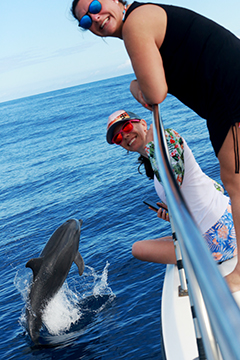
Ah, nature at her best, wild and free. The spinners dolphins often swim right up to the boat and display their aerial skills, being quite the show-offs. They also like to catch a “free ride” on the bow, often spraying your dangling toes with their blows or splashes.
We believe this is the best experience, the free swimming dolphins join us because they want to, not because they are fed or coerced in any manner. It may also be possible to slip into the water and swim in the midst of them. There is really an art to this (respect for the animals being vital), keeping in mind that we are now on their terms.
If it is important to you to swim with wild dolphins, than please be equally prepared.
Please see our “swim with dolphins” page, regarding outside influences which we cannot control – but will give 110% to make the most of… Please realize that due to these influences and that we never know how long the “dolphin swim window” will be open, TIMING IS CRITICAL. When we approach the dolphins, please be focused, attentive, and economical in your movements. Be responsible for your connection with the dolphins.
It is not realistic to expect to swim alongside wild dolphins unless you know how to swim and snorkel, are physically and mentally prepared, are able to get up the ladder and back on the boat, and are potentially able to swim a hundred+ yards at a steady pace.
The more comfortable you are both in the water (“in your element”) and with snorkeling, the higher your rate of success will be. Not being either may turn the “dolphin swim” into a snorkeling lesson for you, and can distract from the success of others.
Things to consider for success, comfort, and your safety;
- Participants must be able to climb a ladder, both sit on a swim step and get up off it, and be able to board and move around the vessel comfortably and with minimal assistance. You must also be able to listen to and follow precise detail, and effectively communicate with the crew.
- Make sure you are present and attentive for all safety and information briefings.
- At times the water can be very deep – you will not be wading in from shore – on some occasions, you may not even see the bottom;
- People have the tendency to overestimate their swimming and snorkeling abilities, and to underestimate their health and/or limitations. If it looks like it may be too much, it probably is.
- The quicker you can be geared up, the better your odds will be. All gear fitting is done before the boat leaves the dock. Time spent taking pictures from onboard, putting on sunscreen, pulling back your hair, finding safe places for glasses, digging for a towel, neatly folding clothes, etc. rather than gearing up will directly subtract from successful in-water time with dolphins. If we are pressuring you to hurry, its because your success rate is going to decrease with the length of time needed for you to get in the water. Timing is a learned art, please trust us, and for the sake of both you and the dolphins, be ready.
- Stay focused on the dolphins, where they are, where they are going, how fast or slow they are moving, how fast or slow different pods are moving, activity levels, if you get in and aim for that pod, and you cant keep up, is there another pod behind it? Be responsible for you trip, if you dont know where they are, get your head up and look. If you know where they are, stay with them.
- Fully grasp the meaning of this profoundly powerful four-word phrase, “Swim with, not at.” Parellel them in every sense of the word. Blend, blend, blend…
- Also, if really important to you, book more than one trip, or take a multiple day trip. Not only are the odds of getting skunked on two trips unheard of, but EACH time you see the dolphins you will be more comfortable, heighten your interaction chances, really hear our guidance, etc.
- There are very few places in the world with these types of near shore conditions where swimming with wild dolphins in their natural habitats, by their own choice (no training or feeding) are available.
Because the dolphins encountered are wild animals, the predictions about their behavior (mood) can best be made through observations before entering the water to swim with them. Our guides are quite adept at dolphin behavior. Moreover, 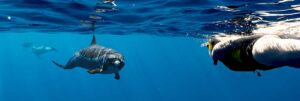 with only 8 guests on shared charters, each encounter is personally tailored to our guests abilities as well as the dolphin behavior. Often our actions maximize either how interesting, or how benign, the dolphins find us. Do we want to invite their curiosity, or do we want to be a ‘fly on the wall’ watching their normal everyday lives? The dolphins or whales may pass by quickly within a few minutes of entering the water, or they may swim in close proximity, curious about these two-legged creatures in their midst. If the dolphins are on a mission and just passing by, then easy to get our small group of swimmers back up on the boat quickly and travel alongside them. We can wait for them to slow for another drop. Or, if very active, it can more fun to watch their acrobatics from the boat!
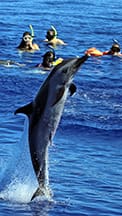
Family Dolphin Swim Ko Olina Oahu
That’s completely up to the dolphins. Encounters are designed to be at the dolphins pace, on their terms, and at their activity level. For the wild dolphins of our coastline, if they’re not into it, we won’t do it.
After 25+ years of interactions with the resident pods, we’ve seen many generations and recognize families. We know how to read them, and know they will only interact if they are comfortable. Or more aptly, the better we mimic and follow their lead, the better the encounter.
We limit our encounters to pre-defined areas. That’s sort of like a security blanket for the dolphins. If they move outside of the envelope, we know the encounters are over – we won’t keep at that them. They’ve come to trust us over the years, and we respect them.
While we do use , SCUBA diving is not conducted. Bubbles may act as a deterrent, and horizontal swimming with the added equipment becomes slow and cumbersome in the presence of agile dolphins.
Your safety is paramount. There is always someone on the boat (if not also in the water with you) watching those in the water.
All participants are given orientation sessions, to become familiar and comfortable with snorkel equipment and the art of dolphin interactions. It is vital that you inform us of any medical conditions o physical limitations that you or members of your party may have.
Spinner dolphins can move at free will if something upsets them or they do not want to be with us. However, we do not want to create such a cause, and will err on the side of precaution at all times.
We will also not let you in the water if we feel the dolphins behavior is at all “sketchy.” This may mean that they sense threat from a predator. We have learned to follow their advice on this. Other reasons we will stay onboard are if the dolphins are traveling (you can’t beat being on the boat for this!).
No, absolutely not. To do so would be to directly interfere with their natural food intake (wild dolphins never eat dead fish), hunting instincts/behavior and their naturally balanced diet.
Different countries have different rules and regulations surrounding cetacean encounters, invariably with the animals’ welfare in mind.
Here in Hawaii, any in-water interactions with dolphins are usually in deeper water most commonly within large pods of spotted dolphins or (IMHO the much more intriguing) pilot whales. Of course opportunities to do so are dependent on a variety of conditions including weather conditions and animal behavior. Our beloved nearshore Hawaiian spinner dolphins have finally been afforded Federal protection and approaching within 50 yards of them is now prohibited.
Additionally, as a certified partner we adhere to the WCA Global Best Practice Guidance Dolphin and Whale Interactions.
Best bet is to leave it to us. You enjoy your journey, and we will document it for you with a photo package.
However we also offer Photography Tours during the calmer summer months. The tours go from deep (sealedges and seamounts) to shallow (coral reef) waters, framing nature above and below the surface. Bring your GoPro or other gear for in-water shots.
You cannot ride the dolphins in their natural, wild setting. No more than you can jump on an wild elephant on the savannah or a wild mustang on the .
A dolphin’s sense of touch is much more acute than ours and moreover, the act of our reaching out to touch could be considered threatening. Attempting to touch the animals could frighten them away, bringing to an end the possibility of a wonderful encounter.
While Hawaii does have year round whale watching – the seasonal humpback whale arrival can begins as soon as Fall. The population increases as the season progresses as different classes of whales leave Alaska at different times. For example, females nursing calves leave the Alaska feeding. So although there are many whales and daily sightings come mid-December, the peak population comes a little later (closer to Feb. – March). Likewise, the most action/behavior viewing is also in the Feb. – mid March era. The single females (now presumably pregnant) are hungry and heading back up to Alaska and similar to “closing time at the bar”, males will be giving a last ditch effort to “catch the gals” (no offense guys)! Soon it will be mostly cows that gave birth this season and their nursing offspring left. It’s a quite and peaceful time of growth, that will soon transform into mom’s teaching and babies practicing breaches and tail slaps. Babies are building muscles and beefing up for that long swim to Alaska.
The best time of day is early morning or later afternoon. Like other mammals, whales tend to be more quiet in the midday ‘siesta’ hours. Not so much that it is hot in Hawaii – but the sun is intense. Also, like other mammals, whales can sunburn too. Humpback whales have lots of protective melanin, but it’s thought that staying a bit deeper and longer under the surface helps to block some of the tropical sunrays.
We do not guarantee specific wildlife encounters or snorkeling, and this is by design.
Our tours take place in the wild ocean, where conditions and animal behavior are constantly changing. While Hawaiʻi’s West Coast is exceptionally rich in marine life—and we very often encounter whales, dolphins, and turtles (frequently all three)—no ethical operator can guarantee what nature will provide on any given day.
Snorkeling is offered only when conditions are safe and appropriate. This is especially important during the winter months, when Hawaiʻi experiences the powerful surf it is famous for. Even on otherwise beautiful days, large swells may be breaking on or near our usual snorkel sites—often the same areas favored by surfers—making water entry unsafe. At times, we may still be able to find a suitable alternative spot; other days, snorkeling simply isn’t possible despite good overall conditions. We operate on the dry side of Oahu – because we don’t get much rain, the water clarity is the best, But a good storm can make the water murky for days, unhealthy and unsafe – even if no swells at all.
We will never put guests in the water if visibility, surge, currents, water quality, or biological hazards (such as jellyfish advisories) make it unsafe—even if other boats choose to do so – because they guarantee a set time of snorkeling. Safety, animal welfare, and environmental responsibility always come first.
We also believe guarantees create the wrong kind of pressure. When “making it happen” becomes the priority, safety and the quality of the experience can suffer. Our crew’s focus is on reading the ocean, respecting wildlife, and delivering the best possible experience for the conditions that day.
Wild Side is Whale Aware–certified and a proud partner of the Whale and Dolphin Conservation (WDC). We follow science-based guidelines designed to minimize disturbance and provide meaningful, ethical encounters—without chasing or forcing outcomes.
In most locations including the Hawaiian Islands, swimming with humpback whales is not allowed. However, we might get in the water near the smaller species of whales that we encounter year-round. For ex. we often swim successfully near pilot whales and pygmy killer whales. All in-water interaction is dependent on whale behavior and water conditions. Perhaps your abilities as well :)
We do require that everyone who gets into the water wear a provided flotation. We require them for safety and visibility (so we can see you). We have ‘ski’ belts or inflatable vests. Neither hinder swimming. Buoyant belts fit around the waist, and water can pass between you and the belt without restricting forward movement. The inflatable vests aren’t buoyant unless blown up. We also have the brick vests that will keep your head above water, enough for everyone in an emergency.
Behaviors are showing that with increasing frequency dolphins prefer and are more attentive to boats, then to swimmers in the water. Your best experience may be to stay on the boat, where you may be able to see the dolphins and their behaviors better, closer, and for longer amounts of time. They can see you too!
Dolphins are often better viewed from the higher elevation onboard. A few feet above the water can make a big difference, and aerial behaviors (spins, leaps, etc.). From the bow, you can look down and see dolphins bowriding and they often turn on their sides to look up at you. The often love to jump the wake as well!
That said, and if conditions warrant, calm and strong swimmers do seem to have the highest “success” rate with the dolphins. Those people who seem to have “animal sense”; are alert, observant, good at reading body language, and position themselves correctly (requiring less physical effort), also do well.
Dolphins generally avoid people displaying aggressive (“charging”) behavior, or excessive splashing. If you are not comfortable in the water, or with gear, you may be distracted from seeing the dolphins swimming below you.
There is an art to the method which is often hard to accomplish in the short 1/2 day time span available. If this is your “life dream” you may want to schedule a few trips to ensure (or increase your odds) that this is realized. Private charters will also give you more personalized attention, and less “competition”.
Snorkeling at the reef is less physical and equally enjoyable with the myriads of tropical fish and turtles. Floaters are welcome! We do all we can to make our passengers familiar and comfortable with snorkeling. However, the best bet is to practice snorkeling at home, the hotel pool, or even the bathtub (!) before you come. Your comfort level in the blue ocean will increase dramatically.
We offer exciting family adventures, allowing children to experience wildlife in its natural habitat, inspiring respect for nature and conservation. When booking, please let us know their ages so we can provide the appropriate life vests and snorkel gear. We trust parents to assess what’s appropriate for their child based on their temperament and curiosity level and to make responsible decisions regarding their safety.
For children under 10, we suggest one adult per child, including in the water. The supervising adult should be a capable swimmer, ideally with snorkeling experience. If this is your first time snorkeling, we highly recommend booking a private charter for a more comfortable, assisted experience.
Children 4 years of age and under are typically allowed only on private charters, though the option of adding a personal guide may suffice. Boating comes with inherent risks, particularly for young children. Toddlers should stay on laps or within arm’s reach of an adult at all times—both on the boat and in the water. Children under 4 feet tall are not permitted to swim in the ‘deep blue’ open ocean.
Please read our terms and conditions, in particular regarding risks and minors. Also, please review photos and videos of the power catamaran on our website to ensure it meets your needs.
All minors under 18 must have a parent or legal guardian onboard.
Did you know that “Jaws” is still rated the #1 scariest movie of all times? This movie has really given sharks a bad rap. Less than one shark attack occurs per year on average in Hawaii. This attack rate is surprisingly low considering that tens of thousands of people swim, surf and dive in Hawaiian waters every day. Despite these statistics, shark attacks remain an emotionally charged topic. Although the odds are mighty slim that you would even see one of the shy, elusive and fast becoming endangered creatures, here’s some tips that may help you feel better.
“Sharks have always been feared since time immemorial and shark attacks can be terrible, but they are few and far between. The media greatly hype shark attacks and few people realize how rare they are… almost anything is more likely to kill human beings than sharks. ” PETER BENCHLEY, author of “Jaws”
However, our ocean is home to sharks, albeit the fearsome predators are usually offshore and not near the areas we frequent. Local residents stress, “Anytime you enter the ocean, you just got lower in the food chain.” This again highlights the reason that we don’t guarantee swimming with dolphins. Imagine we see the dolphins acting somewhat sketchy (shark present?), but we have to consider giving money back, return trips, etc., over your safety?
Motion Sickness Prep (Best Practices)
The day before
-
Consider an over-the-counter motion-sickness medicine per label directions (e.g., meclizine or dimenhydrinate). Taking the first dose the night before can help reduce drowsiness during your trip.
-
Avoid alcohol and get good sleep.
Prescription option
-
Scopolamine patch (by prescription) can be very effective. Apply at least 4 hours before departure (some providers advise the night before).
Important: Wash hands after applying and avoid touching your eyes—residue can cause temporary pupil dilation and blurred vision.
Natural/alternative supports
-
Ginger (capsules, chews, or tea) may help. Typical capsule dosing is 500–1000 mg up to 4 times daily; start the day before or morning of your trip if you’re prone to motion sickness.
-
Acupressure wristbands (Sea-Bands) are drug-free and safe to combine with other methods. Put them on 45 minutes before departure.
Day-of tips
-
Eat a light, non-greasy snack; stay hydrated.
-
Choose a seat with the least motion (mid-ship) and fix your gaze on the horizon.
-
Get fresh air on deck; avoid reading/phone use when you feel queasy.
Safety notes
-
Many motion-sickness meds can cause drowsiness—use caution with driving or alcohol.
-
Talk to your clinician before using if you’re pregnant/breastfeeding, have glaucoma, urinary retention, or heart rhythm issues, or take other medicines.
-
For children, use only age-appropriate products and dosing.
This is general information, not medical advice. Always follow the medication label and your healthcare provider’s guidance.
Getting on and off the boat is fairly easy from the dock. When comfortable, and crew will always be beside you, you will need to step across the water onto the side entry. There are good sturdy railings to grab onto on either side of the entrance. I don’t think there is anyone that has walked down the dock that we havent been able to get onboard.
The sturdy dive ladder on the Hale Kai is deep enough to stand on in the water. The ladder is somewhat angled away from the boat for ease of entry, but still more of a ladder than a staircase.
The orange “Book Now” button will give you our calendar with live availability. You can proceed to book there, or if you have questions you can use our contact form, email us at reservations@sailhawaii.com, or call 808-306-7273. Directly booking through our secure contact form will save you from a 6% booking fee and may also qualify you for other direct booking discounts.
It is best to reserve as early as possible, as last minute bookings are hard to get and/or plan for. We suggest a couple weeks ahead of time, but will accept bookings up to the night before – if space available. Our cancellation policy guarantees a full no-questions-asked (but sympathy expressed!) refund when canceling at least 10 days prior to your departure day.
Gift certificates are available, and a great idea for honeymooners, anniversaries, birthdays, Christmas, etc.
We provide food, drinks, and snacks – these items are listed on the tour descriptions. You can bring anything you’d like, especially if picky eaters or special diets.
Be fully prepared to guard against sunburn, the sun in the tropics is very intense. There is shade on the boat, but glare reflects right on in. Sunglasses (polarized will give you the optimal experience), hats, towels and cover-ups are needed, even in the shade. It is usually best to put SPF 30+ sunscreen on before you leave your hotel room, and again while on your adventure. No spray-on sunscreens please! They over-spray all over the boat becoming a safety hazard, or land on others who may not be appreciative!
We supply snorkel gear, but our supply of fins are geared for “average” adult sizes. Its fine to bring your own equipment if you have, ensuring you a good fit. If you would like to rent equipment while on the islands, we suggest AquaZone – Scuba Diving and Water sports Center 808-923-343 Outrigger Reef Hotel, bottom floor or Waikiki Beach Marriott Shops.
If bringing your own, pack your mask between your clothes so the lens won’t take a beating by the airline’s luggage handlers. If you are bringing fins, pack them near the outside of your bag. Fins are tough and will help protect the more delicate things in the center.
Catamarans are known for their smooth “cut-through-the water” rides. But if there is any possibility for sea-sickness, you may want to start popping ginger pills about a week before the charter date, and/or use sea-bands. Sea bands are elastic wrist bands that work by acupressure, usually available where you would find other motion sickness remedies. They take about 45 minutes to work so put them on ahead of time…
For those who are prone to sea-sickness, always stay out on the deck, looking at the horizon. Avoid going below deck.
Black soles make major scuff marks on boat decks :-( But barefoot is fine!
See Rates page for our prices, and please be aware that on top of the quoted price is State tax and harbor fees, and a $5 per person fuel surcharge .
Find driving directions to the Waianae Small Boat harbor on our map page.
Due to our limited number of guests (6), to keep costs down and still provide personalized quality – we do not provide a shuttle service.
Our solution, TheBus! We have found the total transportation time to be similar to the shuttles of larger tours with various hotel pick-ups. Driving time to our Waianae location is about an hour; time on TheBus (from Ala Moana Shopping Center), is about an hour and a half. We can also help form car pools if do-able, especially for the trip back.
TheBus world-class public transit system costs only $6 round-trip (kids 5yo and under are cheaper or free) to anywhere on Oahu, including Diamond Head, Pearl Harbor, Hanauma Bay, and the Aloha Swap Meet. A month-long pass is only $80 per person. See their rates here
While we do know that you can make it to us on time using TheBus, we also have different departure times and different charters. Please get detailed information on your specific bus departure by calling TheBus Information desk at (808) 848-5555 open daily from 5:30 a.m. to 10:00 p.m., or inquire by email at custserv@thebus.org,
You will need to provide the following information:
- Location you are starting from (we suggest a $10 taxi to the Ala Moana Shopping Center hub– to eliminate transfer and any waiting time between hotel bus and the “C” Express leaving from Ala Moana ).
- Your intended destination – the Waianae (said “Y-N-I”) Intermediate School, that bus stop is across the street from the Waianae Boat Harbor.
- Day and Time you need to get there
- There is also a DaBus Oahu app, check it out, especially if you opt for the month pass! Try this Bus tool also.
Otherwise, check discount rates and reservations for Turo, the air bnb of rental cars here or Uber rates here. Another option is to hire a car with Hui. A car share (similar to a bike share) where you can rent by the hour (no overnight parking fees!) or day.
We have found that rental prices tend to drop anywhere from 1-4 weeks before travel. The theory is that most people make reservations when they book air and hotel, i.e. months in advance, and never look back. Hence the high rates for advance bookings (this is also true for airfares these days). So I have often found very good prices as trip dates approach. Of course it is always wise to lock a fully-cancelable rate…
Half days average 3-4 hours. As we like to beat the wind and sun, check in is at 7am for the sunrise charters and 11:15am for the mid-day charters. If ‘light’ days, we may combine the 1st and 2nd charters together and have a 8:30am check in time.
Over humpback whale season (winter), we do have sunset charters with a 3pm/3:30pm check in – returning near sunset. We’ll catch those golden hours for sure.
In short, cancellations made within the 10 days before departure period and “no shows” will be held responsible for the full price. If we cancel the charter, we will either attempt to reschedule or you will be refunded in full.
Our decisions to go out, cancel, put people in the water (or not), or return to the dock are all carefully considered and reconsidered for each and every charter. We will always make our decisions based on “safety first”, and then what is in the best interest of our guests and the marine life. If we return to the dock early, a fair compensation may be prorated.
The weather is usually moderate year-round, typically ranging from the low 70s to mid 90s. Summer-type clothing, such as shorts, t-shirts, casual pants and sundresses or sarongs are appropriate almost everywhere in Hawaii. We prefer breathable clothing (linen, muslin, cotton, etc.) over the plastic UPF ‘wicking’ type. Those cotton t-shorts are notorious for farmer’s tans, right? Plenty of sunscreen factor.
A hat and polarized sunglasses are also a good idea to protect your face from the sun. And, of course, bring your swimsuits (if under clothes you’re ready to jump in quickly), towel, reef-safe sunscreen and cameras! There’s plenty of (dry) room to bring jackets for winter breezes.
!function(d,s,id){var js,fjs=d.getElementsByTagName(s)[0];if(!d.getElementById(id)){js=d.createElement(s);js.id=id;js.src=’https://weatherwidget.io/js/widget.min.js’;fjs.parentNode.insertBefore(js,fjs);}}(document,’script’,’weatherwidget-io-js’);
Water temp is between 77-82 degrees year-round, depending on depth and topography. Because of the high heat output from the body during active swimming (such as with dolphins), a water temperature of 72 to 75°F is acceptable. With a lower level of activity (snorkeling), a water temperature of 75 to 80°F may be desirable. Ocean temps in Hawaii are normally around 75-76 degrees in the winter and up to 82 degrees in the summer/fall.
A shallow sandy beach like Makua, will be warmer (radiation over sand) than the deeper reef over Makaha. Makaha also has fresh water influx which is cooler. It’s usually coldest in spring as the ocean cools over the winter and warmest in late fall as the sea heats over summer.
When you are wet, you may get chilly onboard from the wind. Don’t forget a towel, they are quite warming when wrapped around you. A rash guard is always a good idea both to protect you from the sun and from any little “stingers” in the water. If you get cold easy in the water, you can always rent a wetsuit the day before at one of the dive shops around the island, such as:
Snorkel Bob’s – https://snorkelbob.com
700 Kapahulu Ave. Honolulu, HI 96816
(808) 735-7944
Aaron’s Dive Shop – http://www.aaronsdiveshop.com
307 Hahani Street Kailua, Hawaii
(808) 262-2333
Based on our historical data over a period of ten years, the warmest water in Waianae was recorded in 2019 and was 81.3°F, and the coldest was recorded in 2012 at 77.7°F. Waianae water temperature is therefore suitable for comfortable swimming all year round. The average water temperature in Waianae in winter reaches 77°F, in spring 77°F, in summer the average temperature rises to 79.9°F, and in autumn it is 80.6°F.
IMPORTANT NOTES:
Bananas are considered bad luck on boats all over the world. Please leave them at home!
Although not in any way necessary, if you have a good day on the water, tipping of the crew is appropriate. (10% to 15% is standard)